
The Winged Lion of Venice is one of the most recognizable symbols in the world. More than a simple emblem, it represents power, justice, knowledge, and protection — and it has shaped the identity of the Republic of Venice for over a thousand years.
You’ll see this majestic creature everywhere: on palaces, bridges, flags, churches, ancient gates, gondolas, coins, and even on modern official documents. But its origins, meanings, and hidden details are far richer than what most visitors imagine.
In this guide, you’ll discover why Venice chose the lion, what the book and the sword really mean, where to find the most beautiful winged lions in the city, and how this mythical creature became the face of a global maritime empire.
🦁 What the Winged Lion Really Stands For
The winged lion represents Saint Mark the Evangelist, Venice’s patron saint. According to legend, an angel told him:
“Pax tibi Marce, evangelista meus.”
“Peace be with you, Mark, my evangelist.”
These words became Venice’s motto — and you’ll find them written on thousands of lions across the city.
The elements of the symbol each have a meaning:
- The Wings → Divine inspiration
- The Book → Wisdom and peace
- The Sword → Justice and protection
- The Halo → Holiness and the sacred role of Venice
- The Lion Itself → Strength, courage, and sovereignty
When the book is open, it symbolizes peace.
When the book is closed or replaced by a sword, it indicates wartime or periods of political tension.
📜 How the Winged Lion Became Venice’s Icon
During the early Middle Ages, Venice needed a strong identity to stand out among powerful neighbors. In 828 AD, merchants from Venice transported the relics of Saint Mark from Alexandria to the city.
The Republic embraced Saint Mark as its protector — and the lion became the state emblem, appearing on:
- official seals
- coins
- naval banners
- palaces and military fortifications
- colonial cities across the Mediterranean
Wherever Venice ruled — from Crete to Cyprus, from Dalmatia to the Peloponnese — the lion followed, carved into gates, walls, and squares. It was the Venetian equivalent of a flag planted on new territories.

🗺️ Where to Find the Best Winged Lions in Venice
You can spot hundreds of lions around the city, but these are the most spectacular:
🦁 1. Piazza San Marco — The Granite Column

The most iconic of all: a bronze lion perched atop an ancient granite column, guarding the entrance to the square.
🦁 2. Porta della Carta — Doge’s Palace

A monumental stone lion holding an open book while the Doge kneels before it — a symbol of Venice’s political hierarchy.
🦁 3. Arsenale Gate

A powerful military lion, representing Venice’s naval supremacy.
Just after the bridge, on the opposite side of the main Arsenal gate, you’ll spot another Lion of Saint Mark carved into the brick wall.
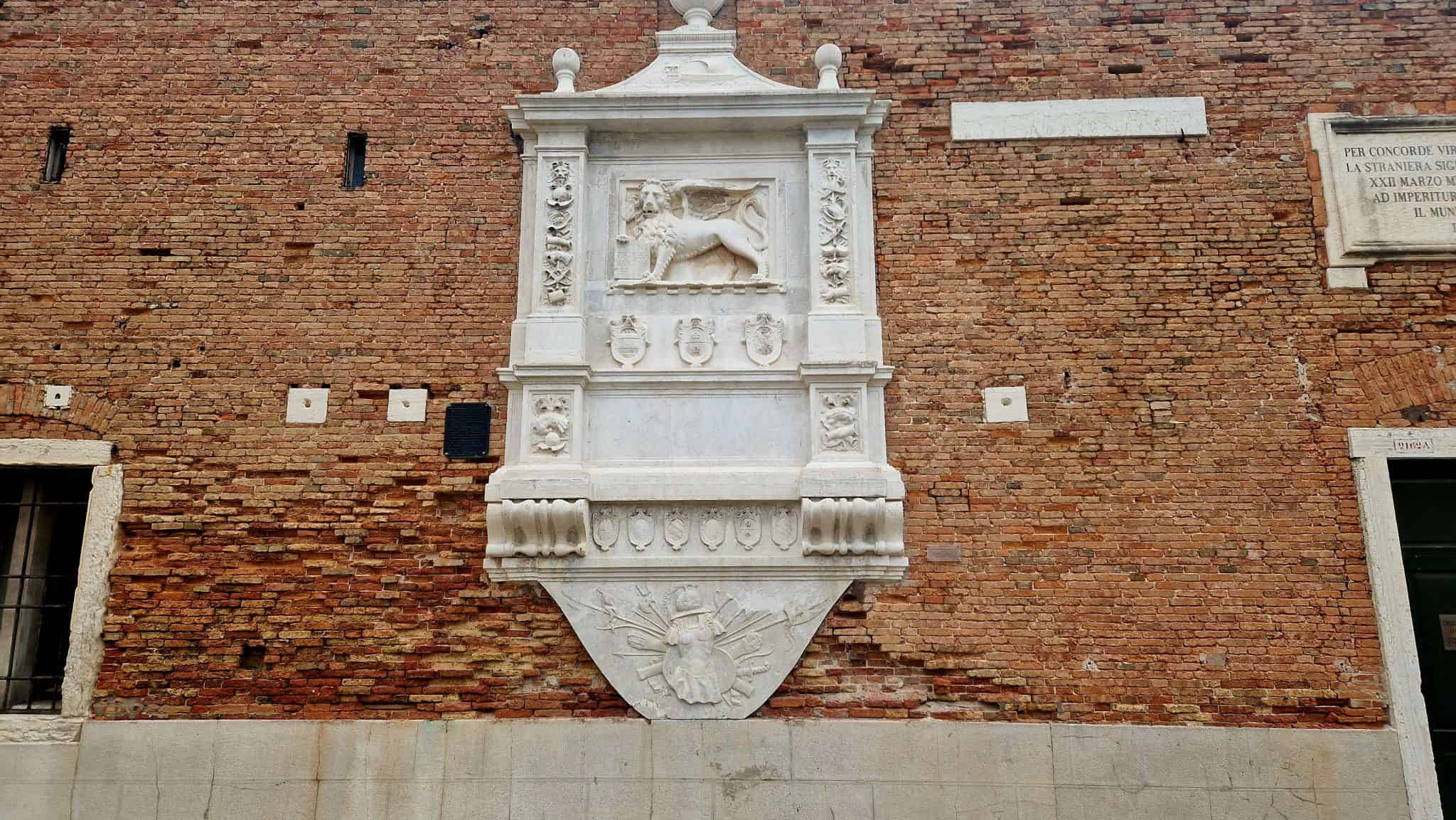
It’s easy to miss if you don’t know where to look — but once you cross the bridge, this marble relief appears on the left, quietly watching over the historic shipyard.
These hidden lions once marked the military heart of the Venetian Republic, reminding everyone that the Arsenale was the power behind Venice’s fleet.
🦁 4. Campo Manin

A dramatic modern sculpture: the lion rises below the statue of Daniele Manin, hero of Venice’s independence.
🦁 5. Via Garibaldi

One of the most authentic streets in Venice, Via Garibaldi also preserves traces of the Republic’s power.
At the beginning of Via Garibaldi from the waterfront side, on the right as you enter the street — just before the post office — you can see a winged lion placed above a historic building.
🦁 6. Zara, Crete, Corfu (Outside Venice)
If you ever travel around the Mediterranean, look for Venetian lions carved in former territories of the Republic.
🦁 Why the Lion Still Matters Today
The Winged Lion is not just a medieval symbol — Venice still uses it today:
- It appears on the flag of Veneto
- It’s the icon of the Venice Film Festival
- It represents the city in sports teams, institutions, and ceremonies
- It continues to be a proud emblem of Venetian identity
The lion has become Venice’s timeless signature — ancient, majestic, and instantly recognizable.
📚 Want to Learn More?
Back to 🌟 Hidden Venice: Fascinating Facts You Won’t Find in Guidebooks
or visit: 🍂 How Venice’s Streets Work: Calle, Campi, Fondamente & Local Names